
Criminal Court Cases in Wayne County
Wayne County criminal court cases divide between two clerks in Loa. Sixth District Court hears every felony and class A misdemeanor. Wayne County Justice Court generally handles class B and C misdemeanors, infractions, traffic matters, and county ordinance cases. Juvenile delinquency matters use regional Sixth District Juvenile Court service and do not appear in public XChange. Choosing only district court can therefore miss a lower-level public case, while choosing only justice court can miss the county's most serious prosecutions.
The court file begins when a prosecutor files a complaint or information, not when an officer makes an arrest. Court staff place filings, hearings, orders, judgments, and dispositions in CORIS, Utah's court information system. Public portions then appear in XChange after staff enter them. That makes the docket the best channel for answering what charge was filed and how the court resolved it. An arrest report remains a separate agency record.
The official Sixth District Court page identifies the Loa court and its local contact point.
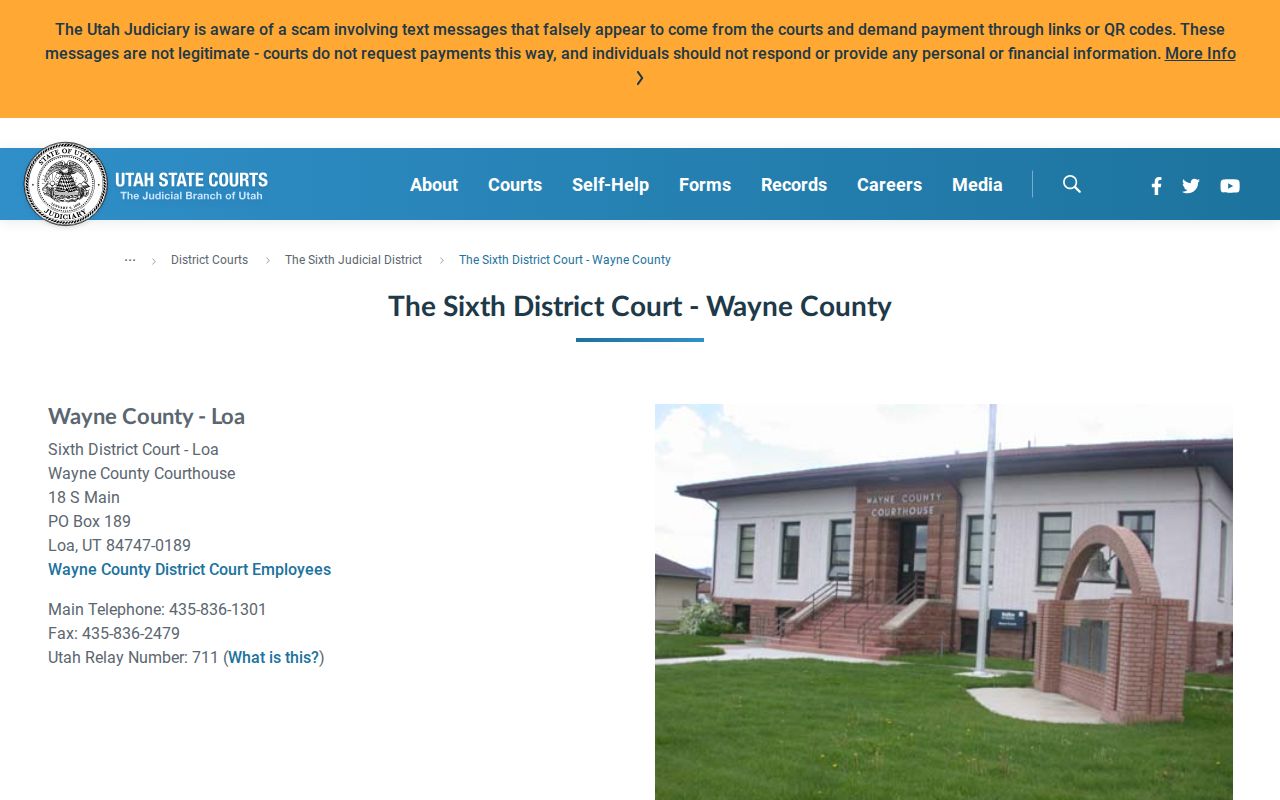
That official listing helps distinguish the Wayne County district clerk from other Sixth District locations.
Wayne County Courts Split the Work
The offense class determines where a state case begins. This split matters because a case number is not unique across all of Utah, and the same name may occur in more than one jurisdiction. A reader who knows whether the allegation was a felony, class A misdemeanor, lower misdemeanor, traffic matter, or infraction can select the more likely Wayne County court before widening the search.
| Court | Wayne County jurisdiction | Contact |
|---|---|---|
| Sixth District Court, Loa | All felonies and class A misdemeanors | 18 S Main, P.O. Box 189, Loa, UT 84747; 435-836-1301; fax 435-836-2479 |
| Wayne County Justice Court | Most class B and C misdemeanors, infractions, traffic, and county ordinances | 18 S Main, P.O. Box 327, Loa, UT 84747; 435-836-1321 |
| Sixth District Juvenile Court service | Juvenile delinquency, excluded from public XChange | Regional contact: 435-896-2700 |
Both offices sit in the same Wayne County courthouse, but their files remain separate. When the offense class is unclear, search both jurisdictions and compare filing dates, defendant birth data where public, and citation details. Court staff can confirm which clerk holds a known case. They cannot advise what a charge means for a party or recommend a legal response. Utah Relay 711 is available through the courts for people who need that access channel.
Wayne County Case Record Searches
Utah Courts XChange is the main remote index for public Wayne County criminal case records. It supports more than a case-number search. A party name, court level, case type, birth date, citation number, and date range can narrow results. Broad queries can return no more than 500 records. Since case and citation numbers are not statewide unique, include Wayne County or the Loa court whenever possible.
- Open Utah Courts XChange and choose district court, justice court, or both.
- Enter a case number, citation number, or party surname and first name.
- Set the search scope to Wayne County or the correct Loa court.
- Narrow by birth date, case type, or date range, then open the case history.
- Contact the clerk when a public document, certified copy, or hearing audio is needed.
The XChange help screens show how the official fields and result links work.
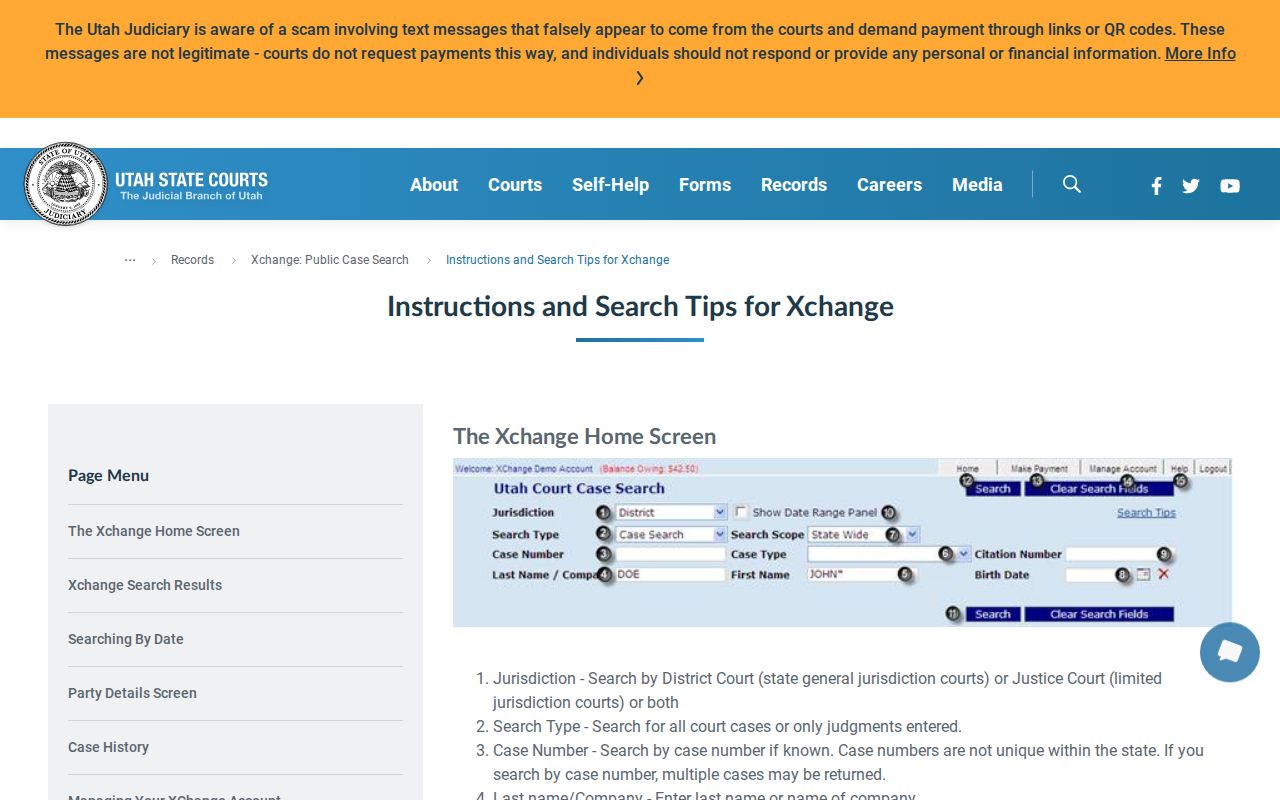
The field layout rewards a narrow search before a reader opens any billable result.
| Field | Type | Use in a Wayne search | Key detail |
|---|---|---|---|
| Jurisdiction | Choice | District, justice, or both | Include both when offense level is unknown |
| Case Number | Text | Direct case lookup | First two digits show filing year; not statewide unique |
| Last Name/Company | Text | Primary party search | Combine with Wayne scope |
| First Name | Text | Optional narrowing | An asterisk returns name variations |
| Birth Date | Date | Defendant match | Often available in criminal searches |
| Case Type | Dropdown | Limits the record class | Select a type or code when known |
| Search Scope | Dropdown | State, county, or court | Use Wayne County or Loa to avoid false matches |
| Citation Number | Text | Traffic or citation search | Narrow by citation location |
| Date Range | Control | Limits filing period | Useful for common names |
Wayne County XChange Costs
Remote access has two account paths. A one-time user funds an account with $10, pays $0.20 per search, and pays $1 for each available document. A subscription has a $25 setup charge and costs $40 per month with 500 searches included. The registration page contains inconsistent text about added-search pricing, so that amount should be checked at purchase. Public electronic district court documents filed since July 1, 2010 are available for $1 each.
The official XChange registration page presents the current account choices and charges.
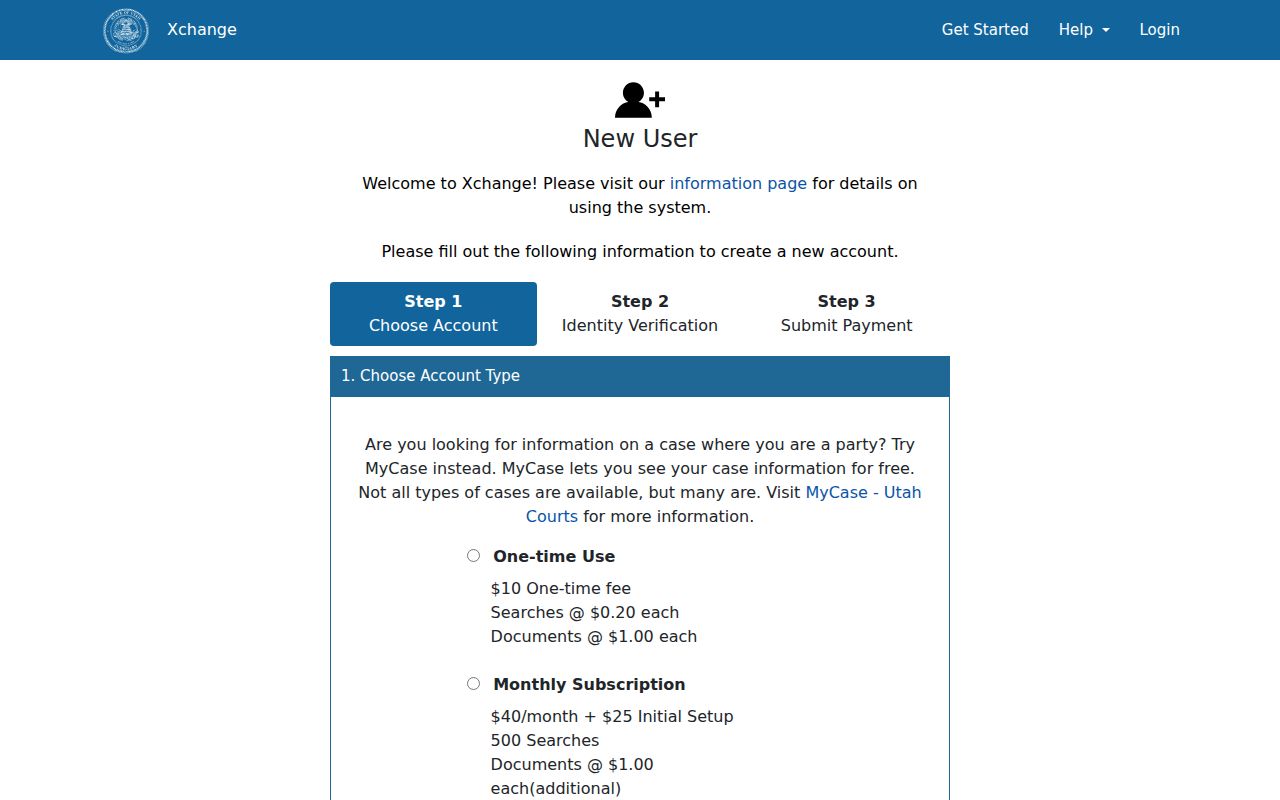
Readers should compare one-time and subscription access based on the number of Wayne County searches they expect to run.
A case-number link opens expanded history, while a separate document link opens an available image for purchase. That distinction can prevent an unnecessary charge when the docket alone answers the question. Copy or certification charges requested straight from the clerk depend on format, so ask for a quote instead of assuming the XChange document price covers a certified court copy.
What a Criminal Case File Contains
A Wayne County criminal case file organizes the prosecution, court events, and result. The header identifies the county, court location, case type, case number, and filing date. Party records may include names, party codes, an available address, and a defendant birth date where entered. The expanded history can list the judge, attorneys, public hearings, filed documents, judgments, orders, and the completed-case outcome.
| Case header | Wayne County, Loa court location, case type or code, number, and filing date |
|---|---|
| Parties | Names, party codes, available address, and defendant birth date where entered |
| Court officers | Assigned judge and attorneys of record |
| Case history | Events, hearings, minutes, filings, orders, judgments, and outcome |
| Documents | Purchasable public district filings where electronic access is available |
| Limits | Up to 500 results; sealed, expunged, juvenile, and designated private cases omitted |
A docket proves that a procedural event was entered. It does not prove every allegation in a complaint. Read through the final disposition and each charge outcome. A dismissal, acquittal, plea, conviction, and expungement describe very different events.
Free Wayne County Court Access
Remote XChange is paid, but most Utah district courthouses provide a free public terminal. Wayne County readers can call the district clerk at 435-836-1301 or justice clerk at 435-836-1321 before traveling and ask whether the Loa terminal is available. Staff may help identify a case, though they cannot give legal advice. The courthouse is at 18 S Main in Loa, where both court levels share the county's main government building.
The Utah Courts CORIS access page explains the free courthouse and clerk-assisted routes.
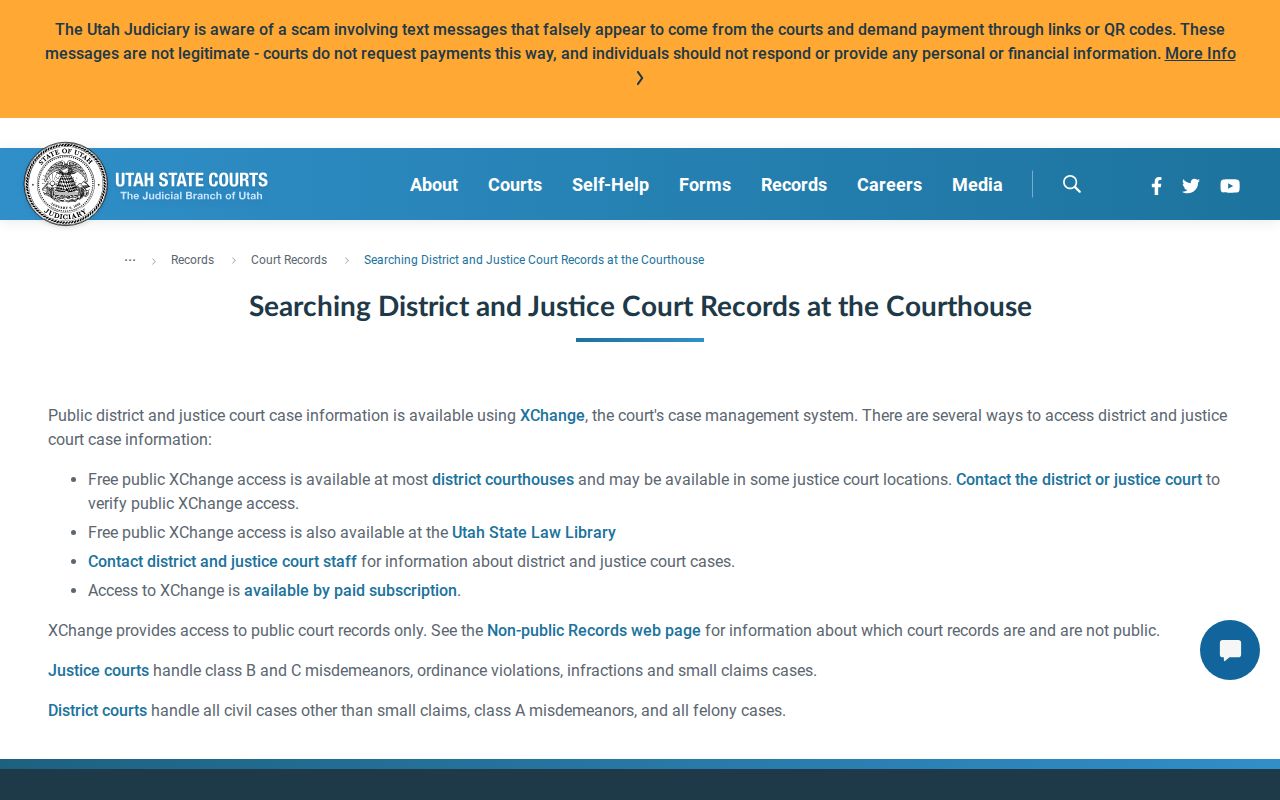
This option is useful when remote search charges would exceed the cost of a planned courthouse visit.
Criminal Case Stages in Wayne County
A Wayne County case does not freeze at the arresting officer's initial charge. A prosecutor decides what to file. The court then records the plea, motions, hearings, result, and sentence. Following the sequence helps a reader tell an early accusation from a completed outcome.
Case flow: Charges Filed › Arraignment › Pretrial › Plea or Trial › Disposition › Sentencing
Arraignment is the hearing at which charges are stated and a plea is taken. Pretrial entries can include motions and later hearing dates. Disposition means the result of a charge or case. Sentencing follows a conviction, while a dismissed or acquitted charge has no conviction sentence. The Wayne County court case lookup remains the route to each public event.
Wayne County Audio and Documents
Some needed material is not attached to XChange. For a Wayne County hearing recording, identify the court, case number, hearing date, and desired format. Sixth District correspondence for specified document and audio requests can go to 6thwaynedocs@utcourts.gov. The clerk can also quote the current charge for a plain or certified copy because the amount depends on the record and format.
The Utah Courts recording instructions describe how audio and transcript requests differ.
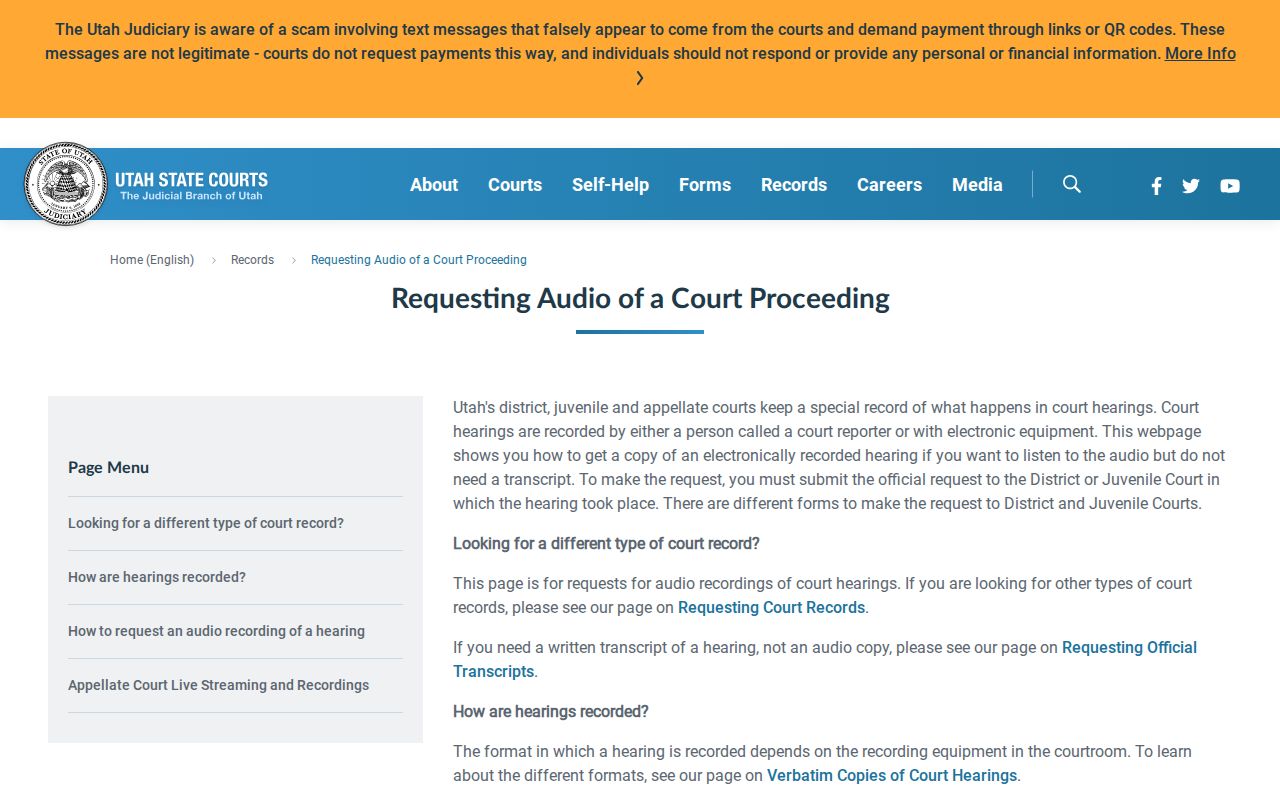
A precise request reduces the risk that staff search the wrong Wayne County hearing or return a different format.
Older Wayne County Case Records
An older Wayne County file may look sparse because Utah justice courts adopted CORIS at different times and converted records can contain less data. Historical court records more than roughly fifty years old may have moved to Utah State Archives. Start with the Loa clerk and the official Utah court-records hub, then follow the archival route staff identify.
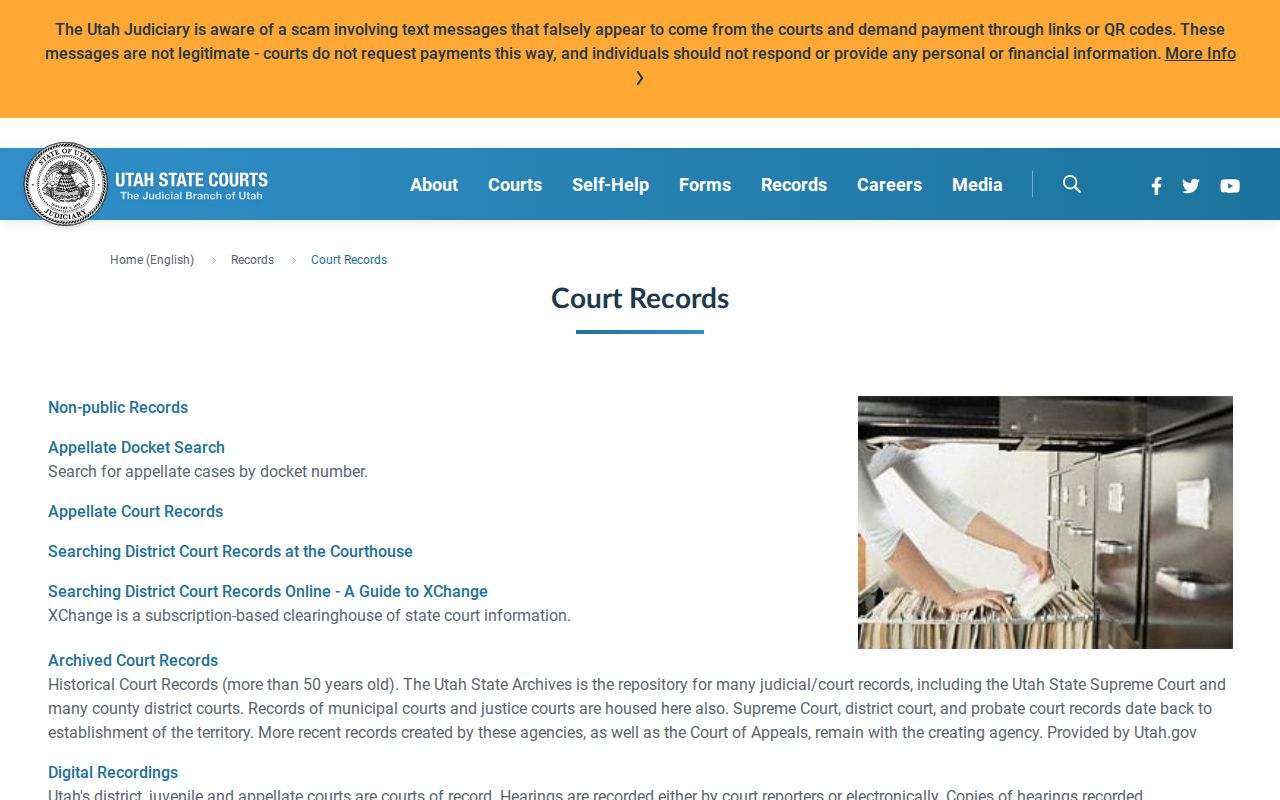
The absence of a scanned document does not mean the original Wayne County proceeding never occurred.
Access Rules for Case Records
Public XChange does not expose every Wayne County court record. Utah court-access rules omit juvenile delinquency cases, sealed or expunged files, and records designated private. Public documents can also carry redactions. A search result that disappears after expungement is not a public acquittal entry; it reflects a legal restriction on access.
GRAMA governs many agency records, but it does not replace the judiciary's court-record rules. Ask the clerk for filed pleadings and orders. Ask the sheriff for sheriff-created incident or arrest reports. Utah Code §53-10-108 also restricts general third-party access to the BCI repository, so XChange should not be described as a complete fingerprint-based rap sheet. These boundaries keep the Wayne County court file distinct from arrest, booking, and state repository records.
When a result appears incomplete, note the exact Wayne County court, case number, filing year, and missing event before contacting the clerk. A focused question makes it easier to distinguish a conversion gap from a private document or an event that was never filed. If the case was expunged, public users cannot use a records request to restore access that the court has lawfully restricted.